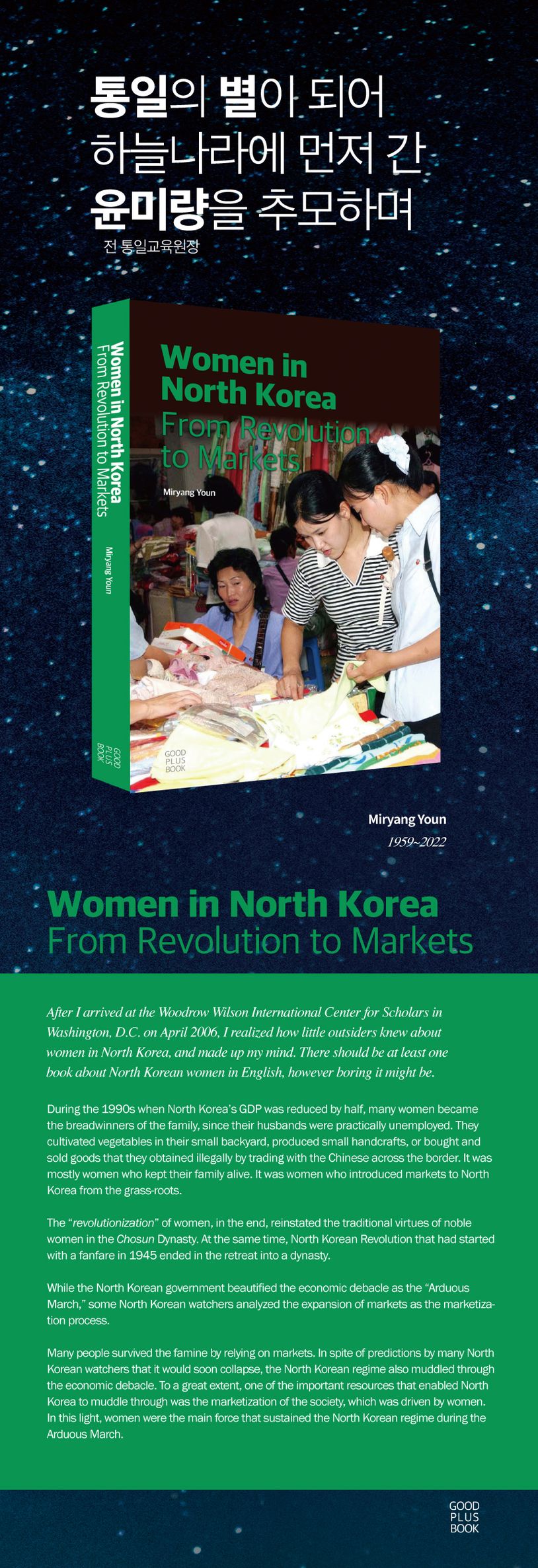
Women in North Korea: From Revolution to Markets

Women in North Korea: From Revolution to Markets

$27.00
Description
Women in North Korea : From Revolution to Markets
The author is an expert on North Korean affairs in South Korea.
She holds a master's degree from Seoul National University and a doctorate from London School of Economics and Political Science, U. K. .
After passing the administrative examination, he worked for 27 years and nine months at the Ministry of Unification, which oversees South Korea's unification policy. He served as the South Korean representative at the negotiating table with North Korea.
She served as the President of Settlement Support Center for North Korean Refugees (Hanawon) from May 2009 to June 2012 and as the President of National Institute for Unification Education from August 2013 to February 2015.
When she was a visiting scholar at the Woodrow Wilson Center in Washington, D.C., in 2006-2007, she realized that there were no English-language books about North Korean women, so she wrote a book for university students and scholars studying North Korea in the United States and other Western countries.
She analyzed the unyielding lives of North Korean women who led a North Korean-style market economy called Jangmadang.

저자는 한국 내 북한 문제 전문가이다. 서울대학교에서 석사 학위를, 영국 런던정경대학에서 박사 학위를 받았다.
행정고시에 합격한 후 한국의 통일 정책을 총괄하는 통일부에서 27년 9개월간 근무했다. 북한과의 협상 테이블에서 한국 측 대표로 활동했다.
2009년 5월부터 2012년 6월까지 북한이탈주민정착지원센터(하나원) 원장을, 2013년 8월부터 2015년 2월까지 국립통일교육원장을 역임했다.
2006~2007년 미국 워싱턴 D.C. 우드로윌슨센터에서 방문학자로 일하던 중 북한 여성에 대한 영문 서적이 없다는 사실을 깨닫고 미국을 비롯한 서방 국가에서 북한을 연구하는 대학생과 학자들을 위해 책을 집필했다. 그녀는 이 책에서 북한식 시장경제인 장마당을 이끄는 북한 여성들의 억척스러운 삶을 분석했다.
저자

Miryang Youn

(1959~2022)


Born in Masan, South Korea, She graduated from Chung-Ang University, passed the Public Administration Examination, and worked for the Ministry of Unification in South Korea from 1987 to 2015.

She holds a master’s degree from Seoul National University and a doctorate from London School of Economics and Political Science, U. K..

From 2001 to 2005, She was a member of the South Korean delegation to the South-North Red Cross Talks, the South-North Shipping Talks, and the South-North Ministerial Talks.

She served as the President of Settlement Support Center for North Korean Refugees (Hanawon) from May 2009 to June 2012 and as the President of National Institute for Unification Education from August 2013 to February 2015.

목차

Preface

Chapter I. Introduction
1.1. Korean Culture on Women
1.2. Colonization of Korea 2
1.3. Kim Il Sung and Women

Chapter II. North Korean Revolution and Women (1945-1953)
2.1. Formation of North Korean System
2.2. Legislation for "Sex Equality"
2.3. Reform Measures for "Sex Equality“
2.4. The Responses of Women

Chapter III. Reinstating the Patriarchal Oder (1953-1989)
3.1. Establishment of the Juche Thought System
3.2. Boasting of the Emancipation of Women
3.3. Working-Classization in Traditional Gender Relations
3.4. Patriarchal Order in the Family
3.5. Male Superiority in the Society
3.6. Under-Representation of Women in the Politics
3.7. Coping Strategy of Women

Chapter IV. The Arduous March and the Hour of the Women
4.1. Kim Jong Il Regime
4.2. The Great Famine and Its Social Impacts
4.3. The Plight of Women
4.4. The Hour of the Women
4.5. Changing Society and Women
Chapter V. Conclusion

Appendices
1. List of Interviews Carried out by the Sejong Institute
Appendix 2. List of Books based on Testimonies of the Refugees
Appendix 3. Major Laws related to the Status of Women
Appendix 4. A Note on the Rape in North Korean Penal Code

References
Index

출판사 서평

Nevertheless, women continued to work outside and inside of the home for the sake of their family and themselves.

It has been seventeen years since I published a book titled The Policy towards Women in North Korea (in Korean, 1991). During the past seventeen years, many changes have occurred, shedding new lights into the life of North Korean people. Kim Il Sung, the supreme leader of North Korea, died in 1994. North Korea suffered a great famine during the mid-1990s. One notable aftermath of the famine was a flood of refugees from North Korea to third nations or to South Korea. There were two inter-Korean Summits in 2000 and 2007, many rounds of separated families' reunion events, and many conferences and gatherings of socio-cultural exchanges. All these changes provided outsiders an opportunity to look into the secretive state.
Many friends of mine urged me to revise the aforementioned book in
accordance with the newly discovered facts about North Korea. However, for me, the new discoveries were rather reinforcing my argument in the book: Although North Korea claimed to emancipate its women as a part of socialist revolution, its political power succession from father to son reinstated the patriarchal social order and subjugated women to men. My argument remained strong and viable after almost two decades of publication. North Korean women were not emancipated, and the policy towards women in North Korea was not emancipating or gender-specific. Therefore I hesitated to add a mediocre book to the overabundant publications in the bookstores. Another book would be a torture to some and a bore to most readers. However, after I arrived at the Woodrow Wilson International Center for Scholars in Washington DC on April 2006, I realized how little outsiders knew about women in North Korea, and made up my mind. There should be at least one book about North Korean women in English, however boring it might be.
If one were to Google the term "North Korean Women," he or she would mostly find news headlines dealing with trafficking, slave labor, refugees etc. This creates an image of North Korean women as poor, weak, and defenseless. The image, of course, correctly portrays a number of North Korean women in desperation. After the great famine struck North Korea in the mid 1990s, many women fled to China and other neighboring countries to obtain foods. Many women were fallen victims to the human-trafficking and slave-labor. However, not all North Korean women were defenseless victims. Many other women vigorously fought against the famine, and survived. They tilted the barren soils and cultivated grains and groceries. They also bought and sold anything that could be changed into money and food. More women than men became the breadwinner of the family and managed the family to survive the famine. They were strong mothers and bald daughters. They were also new economic forces that drove North Korea to marketization.
This book is a history of North Korean women after the Liberation in 1945 to the present. Whereas my aforementioned book of 1991 was about public policy of North Korea, this book is about women's struggle since 1945. My argument is that women in North Korea have always been an active player, not a passive object, in the making of their life and the North Korean history. While North Korean government attempted to grant women "equality" through legal and social reforms, persistent social customs and economic conditions hampered women to gain equality in reality. It was women's struggles and continuous effort to obtain social recognition and change in gender relations.
North Korea launched a communist revolution during the late 1940s. The North Korean revolution attempted to change the whole society and the status of women. North Korean regime promised equality of men and women, and took measures to mobilize women into society outside of the home in accordance with the Marx-Engels' theory of women's emancipation. During this revolutionary era, from 1945 to 1950, women actively participated in social and political rallies and polls. During the disastrous Korean War women took the machines instead of their soldier husbands and sons, and cultivated the rice fields. Many women became the labor heroes and advanced into the Supreme People's Assembly. The proportion of women in the labor force reached up to a half, and the proportion of women in the People's Supreme Assembly recorded around 20 percent since the 1970s.
After North Korea claimed to complete the socialist revolution and designated Kim Jong Il as heir-apparent in the 1970s, however, North Korea began to lose interest on women's issues, insisting that it had accomplished
women's emancipation. Furthermore, the idolization of the Great Mothers, the mothers of Kim Il Sung and Kim Jong Il, demanded women to be loyal to their rulers and husbands. The Confucian tradition was reinstated. Nevertheless, women continued to work o